
'/%3e%3cdefs%3e%3clinearGradient%20id='prefix__paint0_linear_4737_37157'%20x1='3.018'%20y1='23.6'%20x2='44.925'%20y2='24.977'%20gradientUnits='userSpaceOnUse'%3e%3cstop%20stop-color='%231CB7FF'/%3e%3cstop%20offset='.502'%20stop-color='%232FF58B'/%3e%3c/linearGradient%3e%3c/defs%3e%3c/svg%3e)


'Signing players will be like making a playlist': Revealed - the AI app being used to recruit players with the swipe of a finger by clubs including Monaco and QPR, and how Premier League can finally catch up after being '30 years' behind other sports
Apr 07 2026 17:10 · بواسطة Mike Keegan · 30 عدد المشاهدات


Welcome to a world where buying a new left back is as easy as ordering an Uber and where drawing up a list of transfer targets is like plugging a playlist into your Spotify. Sound far-fetched? It should not.
Jake Schuster is the founder and CEO of Miami-based Gemini Sports. After launching a year ago they already have a stable of clients across the football world, including Monaco and Queens Park Rangers . Their aim? To simplify player identification and transfers to the swipe of a finger, thanks to a lot of help from AI.
‘Making a playlist with your wife for a barbecue on Spotify is easy, as it should be,’ the 36-year-old explains. ‘Being told there’s a new episode of your favourite podcast is the same. So why shouldn’t you get a notification when a player you’re interested in has become available?
'We’re not saying that there’s something wrong with the system as it is, but there was nothing wrong with taxis either. Now, we all use Uber because there’s no messing around with money, you can see how far away the car is and you can do it in two clicks. Why should recruitment not improve if the technology is there?’
At the touch of a screen, clubs can access a shortlist via Gemini’s app which is tailored to each club's game model and positional needs. In seconds they can call up the 10 wingers on their radar who score highest on dribbling, for example. They can quickly have access to that player’s agent, their performance details and information on the last time they were watched by the club - all without having to move, make a call or open the laptop.
The idea came when Boston native Schuster, who describes himself as ‘a frustrated athlete’ following stints in lacrosse and wrestling, was studying for his PhD in sports science and conditioning in Auckland.
Clubs can ask the app tailored questions about their squad and recruitment, and the app then produces a shortlist of transfer targets that fit what they're looking for
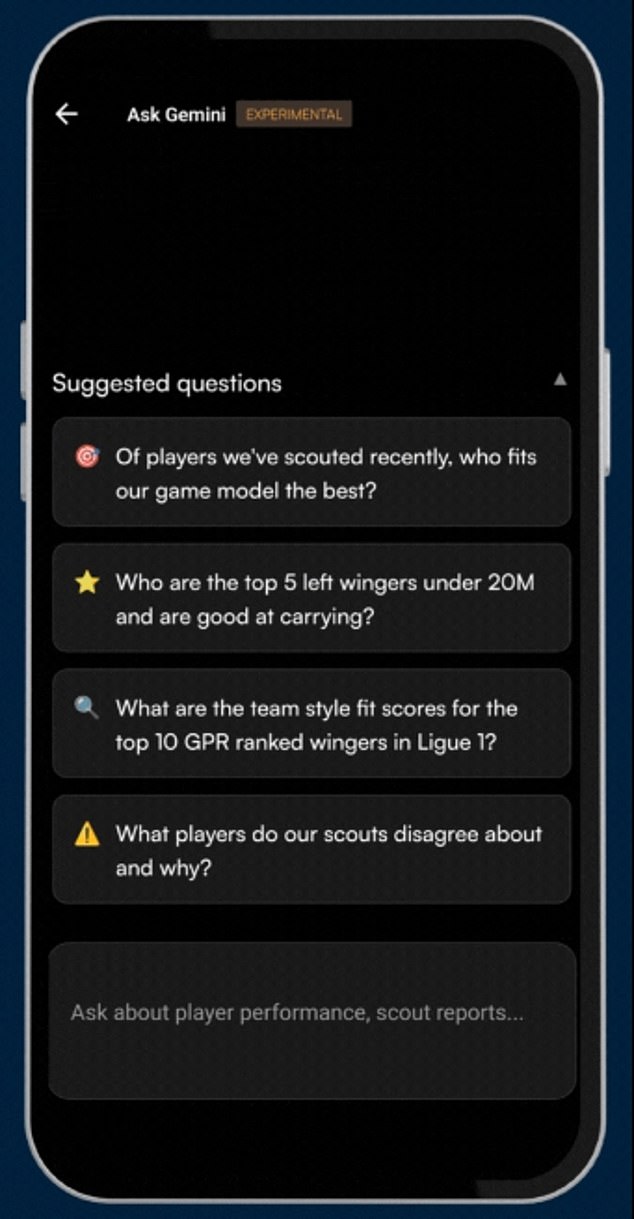
‘It was ridiculous,’ he explains. ‘I had to learn three coding languages. It was just obvious that someone had to make it easier for decision-makers and sporting organisations to actually make use of all the intel they were collecting.
'I spent time with the New Zealand Olympic Rugby Sevens programme at the 2016 Games. While it was amazing to be part of the All Blacks setup, the experience showed me how much friction there was in key decision-making.’
For Schuster, a former performance director at USA field hockey, sports organisations were paying for the data, they just were not utilising it properly – and some of it was the fault of Brad Pitt and a movie about analytics in baseball.
‘The information teams were buying had gone up 60 to 100 times since Moneyball came out,’ he explains. ‘But it hasn’t evolved. You’ve got Jonah Hill’s character, a Harvard graduate, whispering clever things in Brad’s (the general manager, Billy Beane's) ear. I don’t mean to be insulting, but if you look at certain Premier League clubs, they haven’t gone very far past that method.’
Schuster wants to put the power in the hands – literally – of the decision-makers: ‘I just realised there's a real need for self-service tools that sporting directors, technical directors and even owners can actually use to leverage what their scouts are saying.
'You have all these owners, wonderful people, who are pumping all this capital in and yet in a lot of cases they have no idea what is going on at the club. They have no control. This changes that, if they want it to.’
Schuster believes there is much work to be done, and vast potential, on these shores. ‘We started the business post-Covid and went to the NFL and then the NBA,’ he explains.
‘Then, around a year ago I realised that football had a real need around player trading and squad planning. It’s probably 15-20 years behind where NFL and NBA are and probably 25-30 years behind baseball. I see a lot of clubs even at the very top level that are very proud to have two or three technical people, computer people, insights people. They consider that relatively advanced. In baseball, staffs of 40 are considered on the smaller end.
The app has detailed insights into players' injury histories, personal circumstances and more
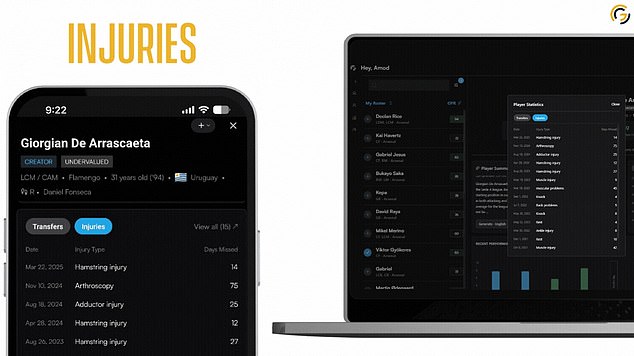
The app already has a raft of high-profile clubs using it, including French giants Monaco

'A lot of clubs at the very top level are very proud to have two or three technical people. They consider that relatively advanced. In baseball, staffs of 40 are considered small'
'It’s not about do we use data or not, it’s about how we use it. Whether you consider it innovative enough to have a clever person next to you bringing you clever ideas, or do you actually believe you need to have the information in your hands?’
None of this is to say that the product is over-simplified, or short on information. ‘It includes all the different streams,’ Schuster explains. ‘Information from data sources, agents, scouts, contracts and finances, it’s all collated.
'Each morning, for example, you can check all the activity that’s going on, the statuses of the players you have on shortlists. Maybe something has happened with regards to one of the players you are targeting and now could be a good time to make a move.’
How the information is obtained, with a heavy lean on AI, is fascinating. ‘Say an agent tells an executive, “this is what the player's salary or demand is”, or "the player's wife is open to moving now because she can’t settle". That information was sent somewhere, sometime on WhatsApp, in a screenshot, with a link to a public website,' says Schuster. 'Having that information can be critical, where AI can not only help you get to answers fast, but it can help you surface things that you need to know.
'We can only fit so much information in our brains. Most clubs are scouting somewhere between 10,000 and 250,000 players to try and get to four or five signings in the summer. You need help.’
Another benefit, according to Schuster, is the continuity the app brings in an industry dominated by change.
‘There’s a huge turnover in football staff,’ he adds. ‘So one element is that the sporting director may go, but all the intel remains at the club. We call this the “hit by a bus problem”. So if someone with all the critical knowledge at the club gets hit by a bus, what are you going to do? How does your world keep turning? That can be a big challenge.’
The product was launched in April and is already being used by clubs in England, Italy, France, Australia, Brazil and Mexico. Monaco are probably the biggest, but QPR and Port Vale are also customers, which Schuster believes highlights how the tool is valuable and accessible at all professional levels.
QPR were the first English club to enlist Gemini's services as they bid to get back to the Premier League

Port Vale are also using the app, as well as clubs in Germany, France and Brazil

‘Monaco had a robust data department to begin with,’ he adds. ‘You might think from the outside they don't need something like this. But they had some really elite innovators who came in from the Red Bull Group and realised that the club had to have a player trading model to survive. They know they’re not going to outspend PSG so they have to prioritise efficiency.’
QPR were the first to enlist Gemini’s services here. ‘They were struggling,’ Schuster explains. ‘They had to change coaches. At one point they were in danger of going down. Now they've really stabilised in the midtable, and I think they've had a couple of pretty successful windows.’
Finding answers is key. ‘One of our customers thought that they were not creating anywhere near enough chances from open play,’ Schuster recalls. ‘But when we looked at the data they were leaking so many goals that their creative players were having to chase back so often. So they plugged the gap and, as the saying goes, the toothpaste was pushed up the tube.
'Football is really in danger of falling way behind. Not to beat this point to death, but just saying that you're being clever, to find a player in a niche market is not enough. You have to have a process that is actually using modern technology.’
Talks are ongoing with a number of clubs across all four leagues in England. ‘It's not just paying for an expensive algorithm,’ Schuster adds. ‘It’s actually about being able to do what you're trying to do as efficiently as possible. Why would you not want that?’