
'/%3e%3cdefs%3e%3clinearGradient%20id='prefix__paint0_linear_4737_37157'%20x1='3.018'%20y1='23.6'%20x2='44.925'%20y2='24.977'%20gradientUnits='userSpaceOnUse'%3e%3cstop%20stop-color='%231CB7FF'/%3e%3cstop%20offset='.502'%20stop-color='%232FF58B'/%3e%3c/linearGradient%3e%3c/defs%3e%3c/svg%3e)

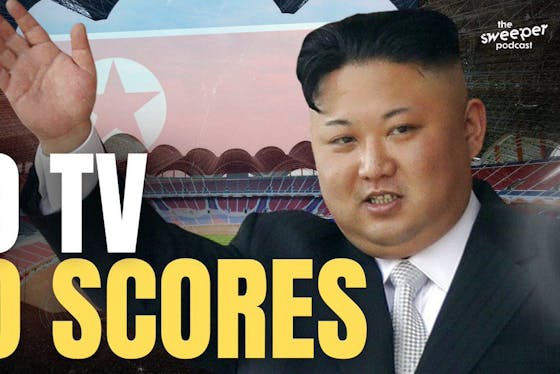
Inside North Korea’s top-secret football league; good luck finding the scores
Mar 07 2026 10:10 · By onefootball.com · 15 Reads


This article was written by The Sweeper Podcast, a weekly world football podcast covering all 211 FIFA countries – and beyond. You can listen to The Sweeper on Spotify here and on Apple Podcasts here .
In North Korea, even football is shrouded in secrecy.
Fixtures in the DPRK Premier League are not published in advance; local fans only discover which matches are on when they are announced outside the stadium the day before.
For onlookers abroad, tracking results in the league is even more challenging. Along with a handful of Caribbean islands and Eritrea, North Korea is the only FIFA country whose domestic game does not feature on live scores apps. And results only filter through to the outside world when state media publish short updates periodically throughout the season.
But there is just about enough information to piece together what form the sport takes in the hermit kingdom. There is a pyramid with three tiers – in both men’s and women’s football. The season runs from December to September and is broken up into three stages. And according to FIFA, the players are amateurs. But as salaried employees of the organisations they represent, they are not amateur in the strictest sense of the word.
By far the most successful club in the country are April 25 Sports Club, who are known as 4.25 for short and are named after the founding day of North Korea’s revolutionary army. Both the record and reigning champions, they have 22 titles in total and even finished as runners-up in the AFC Cup – then the secondary club competition in Asia – back in 2019. The other clubs in the 12-team top flight are mostly based in Pyongyang and are all attached to different industries, factories or government departments.
Most matches take place in the capital, which is home to the world’s largest football-specific stadium. The Rungrado 1st May Stadium sits on an island in the Taedong river that flows through Pyongyang and has a capacity of 114,000. Featuring 16 arches arranged in a ring, it was designed to resemble a magnolia blossom – but looks more like an alien spaceship. The city is also home to the Kim Il Sung Stadium, which is named after the former Supreme Leader and holds 50,000, and the Yanggakdo Stadium, which can fit 30,000 spectators.
Though an unlikely place for football tourism, the more intrepid and adventurous groundhoppers can tick off these stadiums by booking an organised North Korea tour. But it is not for the faint of heart: visitors have been known to have their luggage checked for contraband, are segregated at matches so they do not come into contact with locals, and are shepherded around by local guides who are more like guards than anything else.
Attending games in person is the only way to watch the DPRK Premier League in full. At present, local coverage of the domestic league is mostly limited to compilations or highlights rather than entire matches. In fact, most North Koreans have greater television access to the major European leagues and international competitions than they do their own local game. Nowadays, almost all coverage is of the English Premier League – but it is a very different viewing experience to the rest of the world.
Matches are not broadcast live, but are instead shown with a significant delay – sometimes up to a full year – and are repeated on several occasions. They are also edited down from 90 minutes to around one hour, with cuts to the action reported to be arbitrary and removing important moments on occasion. All English text visible in the stadiums is covered with Korean graphics. And if a team has a South Korean player – like Son Heung Min, formerly of Tottenham – you can bet they will not be shown north of the 38th Parallel.
With its shortened and heavily edited coverage, North Korea appears to have learned from its scarring experience at the 2010 World Cup in South Africa. Following a spirited and disciplined performance in a 3-1 defeat to Brazil in their opening match, the powers-that-be decided to permit their next game to be broadcast live – an occurrence that is almost unheard of in Pyongyang. But a heavy 7-0 defeat to Portugal swiftly put paid to the idea of live international football. North Korea have not returned to a Men’s World Cup ever since.
It has been a similarly long wait for North Korea’s women’s team, who last appeared at a World Cup in Germany in 2011. Back then, five players failed drugs tests after taking a traditional Chinese medicine extracted from a deer’s musk gland. The DPRK delegation defended its use, saying the medication was admitted after several players were struck by lightning. They were swiftly banned from the 2015 World Cup, missed out to arch rivals South Korea on goal difference in 2019 and did not take part in 2023 due to COVID restrictions.
Now though, North Korea’s women have the chance to end their long absence and book their place at the 2027 tournament in Brazil. They commenced their campaign in the AFC Women’s Asian Cup, which is being held in Australia this month, against Uzbekistan yesterday and got off to a winning start. Their remaining group-stage fixtures will be against neighbours China and Bangladesh, with the six nations that make it through to the knockout stages simultaneously securing a spot at the Women’s World Cup next year.
Though they have won three AFC Women’s Asian Cups – most recently in 2008 – the senior women’s team have not enjoyed as much glory as their youth teams. North Korea’s girls are the reigning U17 and U20 World Cup winners. That success has led to the emergence of some strange conspiracy theories, such as their players lying about their age or even being boys! The real reason is much likelier to be that they are housed at the Pyongyang International Football School and are developed together between the ages of seven and 17.
Both Supreme Leader Kim Jong Un and his predecessor Kim Il Sung recognised the potential of women’s football long ago and saw it as a sport with a lower barrier to becoming competitive on the world stage. North Korea are now reaping the rewards at youth level. But they have struggled to translate that dominance into silverware at senior level in recent years. This is largely a product of the circumstances, but also because North Korea does not have a highly competitive women’s league at home, and its players are not allowed to play overseas by the country’s highly repressive regime.